

You Agreed on a Price. The Contract Disagreed.
Agreeing on a price doesn't always mean it stays the price. On this real 2026 Kia Carnival deal, the dealership quietly altered two numbers on the contract, and both changes landed in the dealership's favor.
Negotiating the price of a car is only half the battle. The other half happens in the finance office, after the handshake, once the paperwork gets printed. That's where dealership finance office tricks turn the deal you agreed to into a different one, and almost nobody reads closely enough to catch it.
Reviewing the final paperwork before our clients sign is part of our service. Once the price is set, we go through the contract thoroughly to make sure every number matches exactly what was agreed to. On a brand new 2026 Kia Carnival Hybrid for one of our clients, that review is exactly what caught the problem. The price had been agreed to. Then two numbers came back changed on the contract, and both of them moved in the dealership's favor. Here's exactly what happened, and what it shows you how dealerships can move money around.
The Deal We Agreed To
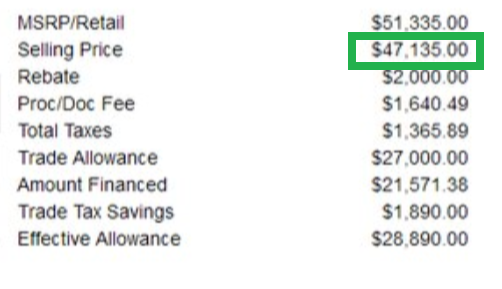
The agreed proposal.
The vehicle is a 2026 Kia Carnival Hybrid with an MSRP of $51,335. After negotiation, the selling price was $47,135. There was a $2,000 rebate and a $27,000 trade-in going toward the deal.
Error #1: The Price Crept Up $233
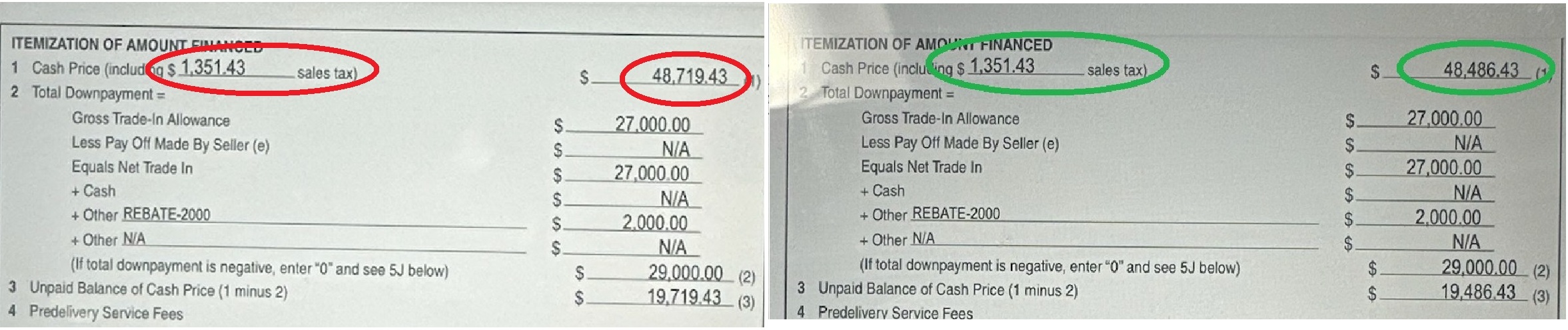
First contract on the left ($48,719.43), corrected on the right ($48,486.43). The sales tax is the same $1,351.43 in both, so there is a $233 difference in the price of the car.
On a contract, you rarely see "selling price" sitting by itself. You see a Cash Price line that already has sales tax baked into it. On this contract, that line read $48,719.43, "including $1,351.43 sales tax."
So you back the tax out:
| Cash price on contract (incl. tax) | $48,719.43 |
| Less sales tax shown | – $1,351.43 |
| Price of the car, as written | $47,368.00 |
| Price of the car, as agreed | $47,135.00 |
| Overcharge | $233.00 |
So where did the extra $233 come from? The proposal listed a "bottom line," but the taxes and registration baked into it were only estimates. When the actual tax and registration came in, they were lower than those estimates. The dealership never mentioned it. So, the dealership quietly kept the difference by increasing the sale price of the car, and the bottom line barely moved.
Error #2: The Rate Was a Full Point High
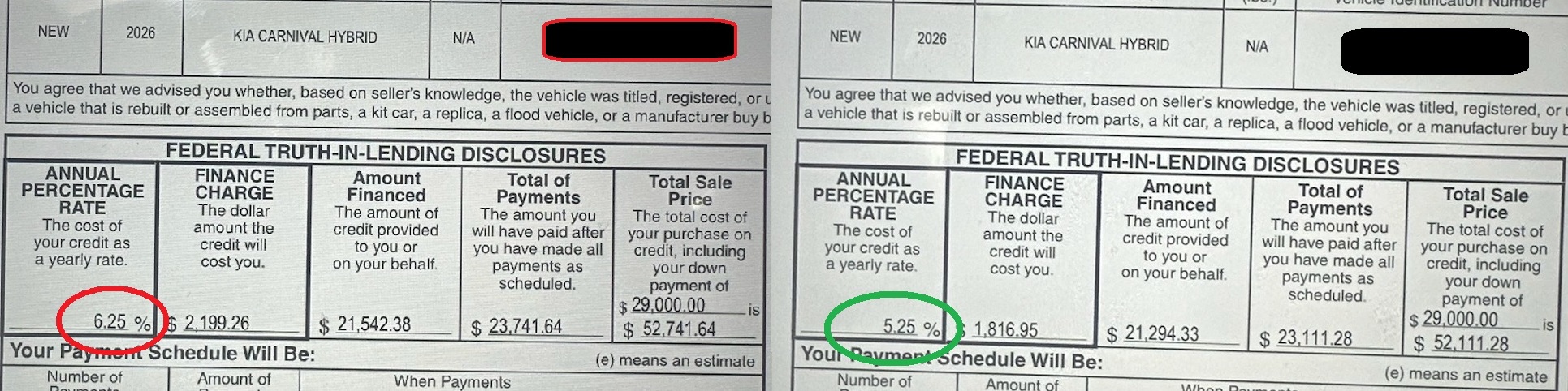
First contract on the left (6.25%), corrected on the right (5.25%). A full point above the rate our client qualified for.
Then there's the rate. The Truth-in-Lending box on the first contract showed an APR of 6.25%. The rate our client qualified for was 5.25%. The difference is a full percentage point.
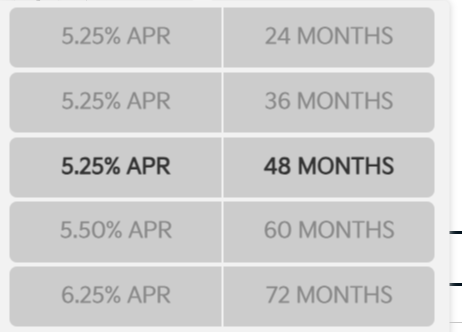
Kia's published rate ladder. 5.25% holds through 48 months; 6.25% only appears at 72 months.
The rate is the easiest place for a dealership to make money, because most people never question it. One point of APR doesn't look dramatic on the page, but it gets charged on every payment for the life of the loan. Watch what that single point does to the finance charge:
| Finance charge at 6.25% | $2,199.26 |
| Finance charge at 5.25% | $1,816.95 |
| Cost of that one point | $382.31 |
That's $382 in extra interest, and there was nothing accidental about it. A full point of APR isn't a typo. It's a calculated, manipulative move by the dealership.
Two Finance Office Tricks, Same Direction
Once both numbers were fixed, the corrected cash price backed out to precisely $47,135, and the APR returned to 5.25%. Here's the combined damage the two "mistakes" would have done if the contract had been signed as first presented:
| Total Sale Price, as written | $52,741.64 |
| Total Sale Price, corrected | $52,111.28 |
| What the two errors added | $630.36 |
The two errors on their own come to $615.31 ($233.00 + $382.31). The Total Sale Price gap is a bit higher, $630.36, because that padded $233 was financed too, so you also pay interest on it over the life of the loan.
Two separate "mistakes," on two different lines, and not one of them happened to fall in the buyer's favor.
What You Should Do
- 1 Anchor on the car price and back it out of every document. Take the cash price, subtract the tax shown, and confirm it equals exactly what you agreed to. Tax and fees will look different on every deal. The price of the car should not move.
- 2 Check the manufacturer incentivized rates against your paperwork. One point (1%) of APR is real money over the life of a loan. If the contract rate is higher than what you qualify for, stop and ask why before you sign.
- 3 Compare the contract to the proposal, line by line. Any number that's different on the contract, even by a few dollars, is worth questioning before you sign.
- 4 Read every line before you sign, because errors are never in your favor. On this contract, two separate numbers were changed, and both benefited the dealership. Assume nothing is too small to verify.
- 5 Don't do it alone. No one should have to buy a car by themselves. Every buyer is up against a dealership trained to pull as much money out of the deal as possible. We spend every day working with consumers to counter those tactics and make the process far less stressful, reviewing every number and every document with you so nothing slips through. Call Your Car Haggler before you sign anything.
When you are ready for a new or used car, we'll help you do it the smart way - not the dealership's way.
Your Car. Your Terms. YourCarHaggler.com
Contact Your Car Haggler →