

What is GAP Insurance?
We talk a lot about avoiding games and schemes at the dealership, but let's talk about something that isn't a game and could save you money and headaches long after you have left the dealership: GAP Insurance.
If your car is ever totaled or stolen, your insurance will only pay what (they believe) your car is worth at that moment (you might have heard this called "Actual Cash Value" or ACV. Importantly, ACV is not what you owe on your loan or lease; rather, ACV is what the insurance company "determines" your car is worth at the moment immediately prior to the loss of your vehicle.
The difference between what you owe and the ACV can be thousands of dollars, and unless you have something called GAP Insurance, you're stuck paying it if your car is worth less than what you owe.
Some states allow dealerships to mark up the cost of GAP insurance and greatly profit from it: while other states, like New York, regulate how much a dealer can make. Because of this, many NY dealerships don't even bring up GAP in the finance office. Instead, they focus on high-profit add-ons like extended warranties and tire-and-wheel packages.
What is GAP Insurance?
GAP stands for Guaranteed Asset Protection. It covers the....gap between what your insurance pays and what you still owe on your vehicle in the event of a total loss.
Here's a quick example:
- You owe on your car loan$28,000
- Insurance totals your car and pays out$23,000
- You're still responsible for — unless you have GAP insurance$5,000
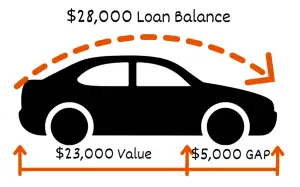
Cars depreciate fast, especially in the first couple of years. If you didn't put much money down (or rolled in negative equity from a prior loan), you're probably "upside down" on your loan for the first few years. That's when GAP insurance can really save you.
So, who needs GAP Insurance?
While every situation is different, GAP is especially important if:
- You're putting less than 10-20% down on your car (depending on the car)
- You're financing for 60 months or longer
- You're leasing with a small down payment (GAP is sometimes built in, but not always)
- You rolled negative equity into your new loan
- You just want peace of mind, knowing you won't owe money on a car you no longer have
- Your insurance company doesn't have a special rider for 'new car replacement'. Some insurance companies have optional riders that will pay out up to 20% over your ACV. Not all 'new car replacement' riders are the same, some will pay over your ACV, but only for a model year newer vs. what you currently have. (*The availability of special riders varies by state).
On the flip side, if you made a large down payment, have a short loan term, or bought a car that holds its value well, you might not need GAP for long, or at all.
Not all GAP policies are created equal. Some are refundable if you pay off your loan early or trade in that vehicle. Some have limits or exclusions. Some will pay 120% and some will pay 150%. It is always important to know what you are buying and what it will cover. If you want us to review yours, we're happy to take a look and explain it clearly.
Bottom line:
When you are ready for a new or used car, we'll help you do it the smart way, not the dealership's way.
Your Car. Your Terms. YourCarHaggler.com
Contact Your Car Haggler →